

The short version
Key takeaways
- Species alone does not determine whether a patio cover lasts.
- Structural grade, member size, moisture condition, detailing, hardware, and finish all matter.
- Douglas fir is often a strong fit for substantial frames; cedar and redwood offer different weight, appearance, and natural durability tradeoffs.
- The final selection should be checked against the engineered design, local availability, and the maintenance the owner will actually perform.
There is no honest “top ten” without the project
A list of attractive species is not a structural specification. The best wood for a small open-lattice patio pergola may not be the best choice for a wide solid-roof pavilion carrying Utah snow. Span, roof load, post spacing, connection design, grade, member dimensions, exposure, appearance, cost, local availability, and finish all influence the answer. Start with the structure and site, then compare species that can satisfy those requirements.
Also distinguish heartwood from sapwood, naturally durable species from preservative-treated material, and appearance grade from structural grade. Two pieces sold under the same species name can perform differently because of grade, moisture, defects, preparation, and where they are used.
Douglas fir: strong timber-frame character
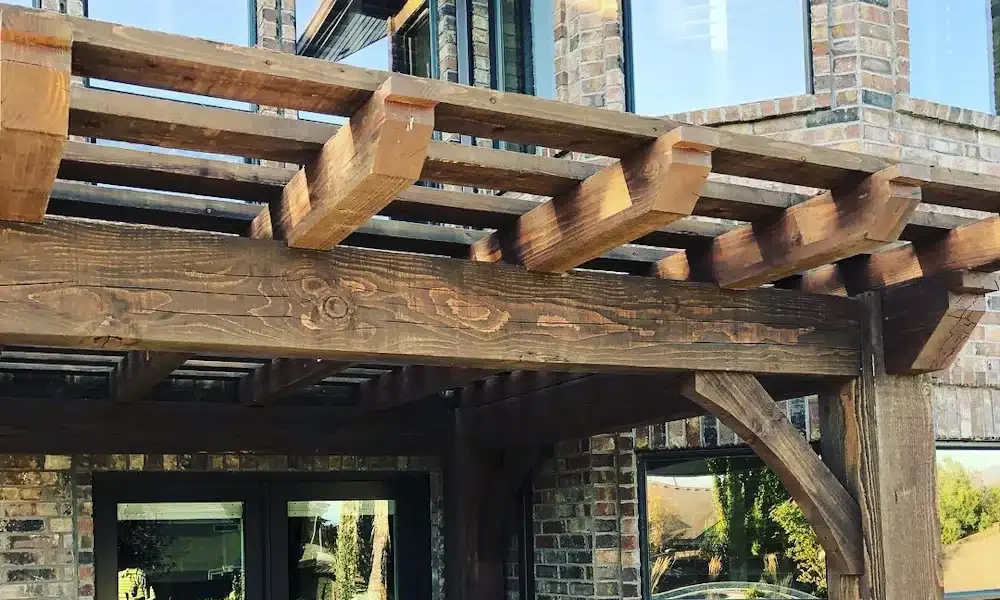
Douglas fir is widely used in structural timber work and is available in substantial dimensions. It is a practical candidate for posts, beams, and rafters when the grade and sizes match the design. Its bold grain and structural presence fit traditional and cleaner-lined outdoor structures.
Douglas fir still needs exterior detailing and a suitable finish. Do not confuse structural strength with automatic decay resistance. Keep it away from persistent ground moisture, protect vulnerable cuts and horizontal surfaces, and maintain the finish based on exposure.
Western red cedar: lighter and naturally durable
Western red cedar is valued for low density, workability, appearance, and natural resistance to decay. Those qualities can make it attractive for exposed rafters, trim, screens, and structures where lower weight is useful. It is not a universal substitute for stronger structural material; member sizes, grade, spans, and connections still need to be checked.
Cedar is relatively soft and can dent or crush at connections if details are poor. Fastener compatibility matters because extractives and exterior exposure can stain wood or accelerate corrosion when the wrong hardware is used.
Redwood: stable, durable, and availability-sensitive
Quality redwood is known for appearance, dimensional stability, and natural decay resistance. It can create a refined patio cover, but grade, dimensions, sourcing, and price vary significantly. “Redwood” on a quote is not enough detail. Ask which grade and sizes are included and whether the structural design actually uses the properties of that material.
Treated lumber and other species
Preservative-treated lumber may be appropriate where material is near ground, exposed to repeated wetting, or used in a hazard condition that calls for treatment. Treatment category, retention, incising, drying, fastener compatibility, and appearance should match the application. Pine, spruce, cypress, oak, tropical hardwoods, and engineered products can have legitimate uses, but a nationwide list does not make each one sensible or available for a Utah timber-frame project.
Very dense exotic woods may be durable yet difficult to source in large structural sizes, heavy to lift, hard on tools, and expensive. Some familiar softwoods are economical but need treatment or protective detailing in exposed conditions. Decide from the complete assembly, not the species reputation.
Questions to put on the quote
Ask for the species and structural grade, the intended moisture condition, exposed member sizes, treatment where applicable, finish brand and system, hardware material/coating, roof assembly, site-work responsibilities, and maintenance expectations. Confirm whether the quote includes prefinishing, touch-up after cutting, delivery, unloading, installation, roofing, flashing, gutters, and periodic maintenance. This is how two apparently similar patio-cover quotes stop being mysterious.
Use this on site
Project checklist
- Confirm the roof type and design loads before choosing member sizes.
- Specify species and grade, not only “wood.”
- Match hardware and fasteners to the timber, treatment, and exposure.
- Choose a finish after reviewing samples on the actual prepared wood.
- Keep posts and vulnerable cuts away from persistent moisture.
- Write maintenance and scope responsibilities into the proposal.
Common questions
Questions homeowners ask
Is cedar always better than Douglas fir?
No. Cedar offers lower weight, workability, appearance, and natural durability; Douglas fir often offers stronger structural properties and substantial timber sizes. The design and grade control the decision.
Is pressure-treated pine a good patio-cover material?
It can be appropriate for some exterior or near-ground applications, but treatment category, drying, appearance, checking, dimensions, and fastener compatibility need to fit the design.
What wood lasts the longest outdoors?
Service life depends on natural or treated durability, moisture exposure, detailing, finish, maintenance, and construction quality. A durable species can still fail early when water is trapped.
Primary references
Sources and further reading
These references support the technical principles in this guide. Project-specific plans, product instructions, engineering, and local requirements still control the work.
- Wood Handbook: Wood as an Engineering MaterialUSDA Forest Products Laboratory. Reference for wood species, moisture behavior, mechanical properties, decay, fasteners, and exterior use.
- Wood Handbook, Chapter 14: Biodeterioration of WoodUSDA Forest Products Laboratory. Reference for decay conditions, natural resistance, preservative treatment, and moisture control.
- Finishing Wood ExteriorsUSDA Forest Products Laboratory. Research-based guidance on preparation, paints, stains, water repellents, weathering, and maintenance.